what will be needed to keep pets, farm animals and wildlife safe and healthy as the climate changes?
Photos.com
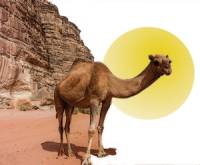
Animals have some astonishing adaptations that help them live in fifty-fifty the about hostile environments. Consider camels, for instance. They can thrive in some of the hottest and driest places on World. Their legs don't get burned when they kneel on hot sand due to thick leathery patches on their knees. They can survive for an entire week without water but, at the same time, they can drink 32 gallons of water at one time. Their body temperature ranges from 93 °F to 107 °F, so they don't need to sweat very often and tin conserve water this way. The spongy basic in their noses absorb any backlog moisture to proceed every drib of water in, so the air they exhale out is dry air. In addition to camels, other animals' adaptations are as remarkable. How practise they do information technology? Chemistry helps!
Warm-Blooded or Cold-Blooded?
The nigh important adaptation is how animals regulate their body temperature. Animals can be either warm-blooded or cold-blooded.
Warm-blooded animals, which are mostly birds and mammals, demand to maintain a relatively constant body temperature or they would suffer dire consequences. It doesn't matter what the exterior temperature is—they must maintain the same internal temperature. For usa, the commonly accepted average body temperature is 98.6 °F (even though it may vary amid individuals). Near other mammals range from 97 °F to 103 °F; birds take an average body temperature of 105 °F.
Cold-blooded animals do not maintain a abiding body temperature. They get their heat from the exterior environment, so their body temperature fluctuates, based on external temperatures. If it is 50 °F outside, their body temperature will eventually drop to 50 °F, as well. If it rises to 100 °F, their torso temperature will accomplish 100 °F. Nigh of the rest of the animal kingdom—except birds and mammals—are cold-blooded.
In most instances, the size and shape of an organism dictate whether it will be warm-blooded or cold-blooded. Call back about some large animals—elephants, whales, and walruses. Their volume is so large that relying on the outside environment to oestrus them upwardly would be inefficient and would slow their response times, putting their survival at risk. For that reason, nearly all large animals are warm-blooded.
What about all the birds and mammals that are not large, such as mice and sparrows? The other cistron—torso shape—comes into play here. Minor warm-blooded animals tend to have a rounded shape, which ensures that the interior of an organism stays warm the longest time possible. Most cold-blooded organisms have either an elongated or a flat shape. If yous wait at a typical fish, their bodies tend to be flat when viewed caput-on from the front. Snakes, lizards, and worms tend to be long and slender. These shapes ensure they can oestrus up and cool down rapidly.
Within a given species, animals tend to be larger in colder climates and smaller in warmer climates, an ascertainment known as Bergmann's dominion. For example, whitetail deer in the southern part of the United States tend to take a smaller body size and less overall mass than whitetail deer in the far northern states.
At that place are exceptions but, overall, this rule holds true, for the following reason: Equally the book of an object decreases, the ratio of its surface surface area to its book increases. In other words, the smaller an beast is, the higher the surface area-to-book ratio. These animals lose heat relatively quickly and cool down faster, and then they are more likely to be plant in warmer climates. Larger animals, on the other mitt, have lower surface area-to-volume ratios and lose heat more slowly, so and they are more than likely to be found in colder climates.
Generating Energy
Warm-blooded animals crave a lot of energy to maintain a constant body temperature. Mammals and birds crave much more food and free energy than exercise common cold-blooded animals of the same weight. This is because in warm-blooded animals, the heat they lose is proportional to the surface area of their bodies, while the heat they produce is proportional to their mass. This means that larger warm-blooded animals tin can generate more rut than they lose and they can continue their body temperatures stable more easily. Smaller warm-blooded animals lose heat more than quickly. So, information technology is easier to stay warm past being larger. Warm-blooded animals cannot be too small; otherwise, they will lose heat faster than they can produce it.
This energy produced by warm-blooded animals mostly comes from food. Food represents stored chemical energy (potential free energy), which is converted into other forms of energy within the body when the food is metabolized. Metabolism refers to the all of a torso'south chemical reactions.
The metabolism of food within the body is ofttimes referred to equally internal combustion, since the same byproducts are generated equally during a typical combustion reaction—carbon dioxide and water. And like combustion reactions, metabolic reactions tend to be exothermic, producing rut.
For a warm-blooded animal, food is non just a luxury—it is a thing of life and death. If nutrient is not available for energy, the body'southward fat is burned. In one case fatty reserves are used upwards, death is imminent if a food source is not found. The smaller the warm-blooded animal, the more than it must eat—relative to its body size—to proceed its internal furnace stoked. That'south why most songbirds fly southward for the winter.
These turtles but walked out of a pool of cool h2o.
NASA/JPL-CALTECH
On the other paw, cold-blooded animals crave less energy to survive than warm-blooded animals practice, because much of the energy that drives their metabolism comes from their surround. Information technology is common to see turtles basking in the dominicus on rocks and logs. They are not trying to get a suntan, but rather are revving upward their metabolism. The sun gives them an energy boost. Muscle activeness in cold-blooded animals depends on chemic reactions, which run chop-chop when it is hot and slowly when it is cold (considering the reacting molecules move faster when temperature increases).
Some reptiles, such equally the python, can go a year without eating, because they practice not apply food to produce torso estrus. And if they lie nevertheless, they use footling free energy, so they can afford to eat petty.
Cold-blooded animals have a disadvantage compared to warm-blooded animals: There is a sure temperature below which their metabolism just won't work. The reason is that all chemical reactions slow down equally the temperature is lowered, so at low temperatures, all the chemic reactions in an organism slow down.
You may find that few common cold-blooded animals are active in the winter, and the farther north yous go, the rarer they go. By dissimilarity, warm-blooded animals are present in a wider variety of environments and for a longer part of the twelvemonth than common cold-blooded animals.
Hibernation
For warm-blooded animals that don't migrate, one way to survive the winter is to sleep through information technology. Hibernation is a great strategy that enables animals to conserve energy when food is scarce. During hibernation, body temperature drops, breathing and heart rate slows, and most of the trunk'southward metabolic functions are put on agree in a state of quasi-suspended animation.
Information technology is almost as if the warm-blooded beast becomes cold-blooded, every bit its torso temperature drops considerably. But they are nevertheless live, and they live off their fatty reserves. Hibernation for extended periods of fourth dimension is only accomplished past those animals that tin can store a great deal of body fat, such as bears, groundhogs, and chipmunks. A black behave loses fifteen%–30% of its weight while hibernating.
Common cold-blooded animals hibernate, also. But they demand to shop less fat than warm-blooded animals because they require less free energy. Turtles and frogs coffin themselves in mud nether lakes and ponds for upwards to six months at a time, and for all practical purposes, they appear expressionless. There are no external signs of life.
When many cold-blooded animals hibernate, something interesting happens at the cellular level. The fluid around the cells, just not in the cells, is frozen solid. As h2o freezes outside the cell, water from inside the cell is fatigued out through osmosis. Osmosis is a procedure in which h2o moves beyond a semipermeable membrane—in this case, the cell membrane—from an area of low solute concentration to an area of high solute concentration.
As water freezes outside of the cell, the solute concentration increases, because the quantity of liquid water decreases while the amount of solute stays the same. As a result, water flows out of the jail cell to equalize the concentrated solution outside of the cell (Fig. 2).
At the same time water is leaving the cells, glucose migrates into the cells in copious amounts. By removing water and adding glucose, the concentration of dissolved solute within the prison cell increases—a lot. The glucose acts as a natural antifreeze, equally whatsoever solute volition lower the freezing point of a given solvent—in this case, water. The presence of loftier concentrations of solutes in the cells allows animals such as frogs to hide at temperatures beneath freezing and still survive. While the water around the cells is frozen, the water in the cells is not. If water within a cell were to freeze, the prison cell membrane would be ruptured, killing the cell.

ISTOCK
Keeping Warm
When it is cold outside, yous put on more than clothes. Your winter coat does not keep out the cold, but rather keeps in the heat. (Common cold itself doesn't exist—it is only the absence of heat; run into the commodity titled "Why Cold Doesn't Exist," on p. 10.) Birds and mammals too rely on insulation to forbid heat loss. The most effective insulation traps air, since air is one of the best insulators. Wool tends to be warm because its fibers are curled, effectively trapping air and keeping y'all (and sheep) warm. Birds fluff up their feathers when they want to stay warm, since fluffing introduces air.
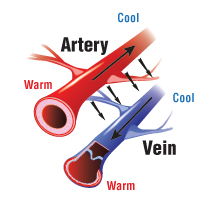
For mammals without hair, insulation is accomplished past blubber, a thick layer of fat tissue which helps to insulate an animal's body because fat does non transfer heat likewise equally muscle and peel. This blubber may be two feet thick in some whales! Whales, tuna, dolphins, and other warm-blooded marine animals also rely on another ingenious method to conserve estrus. To prevent excessive heat loss from extremities such as fins and flippers—which are not well insulated—aquatic animals rely on a "countercurrent rut-exchange method," in which the arteries that conduct warm blood away from the heart are positioned directly confronting the veins that carry absurd blood to the heart. So, the warmer blood leaving the eye through the arteries warms the cooler blood entering the heart through the veins.
In contrast to birds and mammals, lizards, frogs, snakes, and other cold-blooded animals do not need insulation—it would just slow down heat transfer into their bodies.
Shutterstock
Keeping Cool
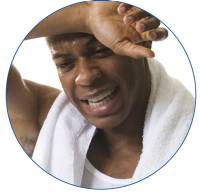
When you lot get hot, what'south the first affair that happens? You start to sweat. The average adult has 3 million sweat glands. It's not the sweating that cools you, but rather the evaporation of this sweat. Evaporation is an endothermic phase change, meaning information technology must absorb energy to occur. This energy is drawn from your body, making yous cooler.
Photos.com
Someday you lose energy, your body will feel cool. Evaporation requires energy because forces of allure betwixt h2o molecules—called intermolecular forces—need to exist broken when water goes from a liquid to a gas. In liquid water, the molecules are shut together and are attracted to 1 another. Evaporation requires energy because the intermolecular forces of attraction betwixt water molecules in the liquid stage must be overcome when water goes from a liquid to a gas. The free energy that goes into overcoming these bonny forces comes from your body.
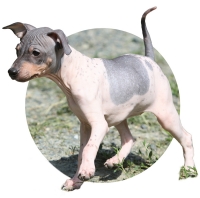
Do animals sweat? Most don't, but some do. Dogs sweat mainly between the pads on the bottom of their paws. Ane notable exception is the American hairless terrier, which has sweat glands all over its trunk, illustrating the fact that fur tends to inhibit sweating considering if the sweat can't evaporate information technology doesn't help in the cooling process.
Cats not only have sweat glands on the pads of their feet, but also on their tongues! When a cat licks itself, it may not be just to keep clean, only information technology could too be to cool itself as the saliva on their fur evaporates. Kangaroos volition lick their forearms for the same reason.
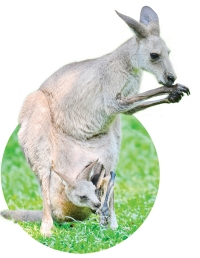
Kangaroos keep cool past licking their forearms.
Shutterstock
The key to surviving in hot climates is not only to go on your body from overheating but besides to forestall water loss. Animals that are adjusted to desert life are not heavy sweaters—because water is scarce, they cannot beget to lose it by sweating. Also, a not bad deal of h2o is lost through animate out, then desert animals miscarry dry out air, reabsorbing the water in their breath before it has a take chances to be expelled.
The power of animals to adjust to farthermost environments is quite remarkable. Whether it is in the freezing corners of Siberia or the sizzling hot desert of the Sahara, animals ever discover ways to survive, and how they do it will never cease to amaze us!
Brian Rohrig teaches chemistry at Metro Early College High School in Columbus, Ohio. His most recent ChemMatters article, "Non Milk? Living with Lactose Intolerance," appeared in the April 2013 issue.
Source: https://www.acs.org/content/acs/en/education/resources/highschool/chemmatters/past-issues/archive-2013-2014/animal-survival-in-extreme-temperatures.html
0 Response to "what will be needed to keep pets, farm animals and wildlife safe and healthy as the climate changes?"
Post a Comment